As surgical training evolves beyond the traditional model, the demand for rigorous, scalable competency assessment has become a number one priority. In gynecologic surgery, where technical precision affects patient outcomes, simulation-based platforms like the Miya Model are reshaping how trainees are evaluated, trained and certified.
The transition from unobjective, observation-based evaluation to metrics-driven assessment represents a large shift in surgical education. Residency programs, credentialing and hospital systems alike are under increasing pressure to demonstrate that surgical competence is measured, documented, and validated.
The Limits of Traditional Competency Evaluation
For generations, surgical ability has been evaluated through the informal judgment of attending surgeons, based on time spent in the operating room, procedures observed, and cases assisted. However, this approach has notable limitations, such as relying on subjective assessment. It is also influenced by differences in patient case complexity and raises ethical concerns about trainees “developing skills” on live patients in the earliest stages of their learning.
Research published in surgical education literature consistently demonstrates that when two experienced surgeons evaluate the same trainee’s performance, their scores frequently diverge. This is not because one is wrong, but because the overall impression is an imprecise instrument. In gynecology specifically, where laparoscopic and hysteroscopic procedures require fine motor coordination and spatial reasoning under anatomical time pressure, imprecision carries a risk.
The Miya Model: A Validated Simulation Platform
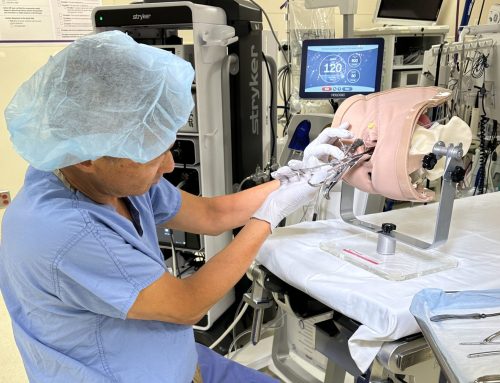
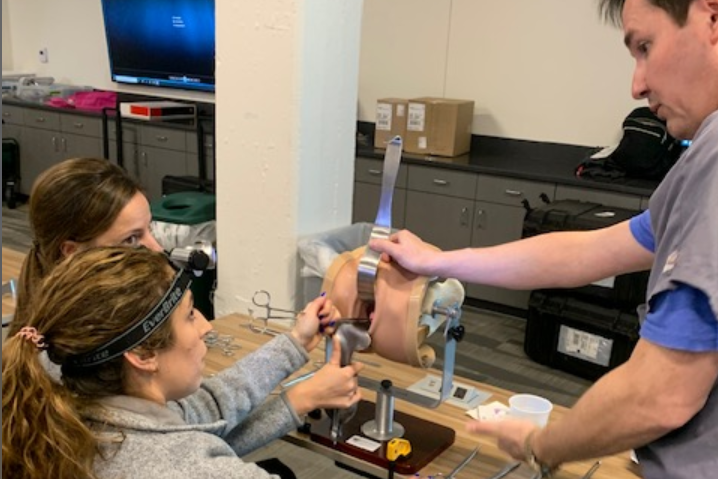
The Miya Model is a high-fidelity pelvic surgical trainer designed specifically for gynecologic procedures, including hysteroscopy, intrauterine instrumentation and cervical dilation. The Miya Model replicates the tactile and anatomical characteristics of the human pelvis with a level of biomechanical fidelity that supports procedural skill transfer to clinical settings, for a realistic surgical experience.
What distinguishes the Miya Model from earlier-generation phantom trainers is the growing body of validity evidence supporting its use as an assessment tool, not solely for practice. Validity in medical education follows a structured framework encompassing content validity, which asks the question, “Does the task mirror the real procedure?” Construct validity ensures that it can discriminate between novices and experts, and criterion validity finds that the scores predict real-world performance. Published studies evaluating the Miya Model have addressed each of these domains with rigor and completeness.
Construct Validity and Novice-Expert Discrimination
Several peer-reviewed investigations have demonstrated that performance metrics on the Miya Model, including procedure time, instrument force application, number of attempts, and error frequency, consistently differentiate between trainees at different experience levels. Novice practitioners, who are medical students or first-year residents with minimal procedural exposure, perform significantly worse across all quantitative metrics compared to experienced gynecologic surgeons. This novice-expert gradient is a foundational requirement for any assessment tool seeking to serve as a competency benchmark.
Importantly, performance on the Miya Model shows a learning curve pattern consistent with skill acquisition theory: initial rapid improvement followed by a performance plateau. This expert-level plateau offers a practical threshold for competency benchmarking, providing programs with a defensible pass/fail criterion grounded in empirical data rather than program director intuition.
Objective Metrics: A Modern Assessment
The shift toward objective metrics in simulation-based assessment aligns with broader movements in competency-based medical education (CBME), which emphasizes demonstrated ability over time served. In this framework, the Miya Model’s measurable outputs function as performance indicators that can be tracked and shared across training institutions. They are also subjected to standardized benchmarking.
Metrics captured during Miya Model assessments include procedural completion rate, instrument path efficiency, excessive force events, and time-to-completion normalized against expert performance norms. These key data points can be aggregated into composite performance scores or reviewed individually to target specific technical deficits for remediation.
Implementing Miya Model Assessment in Residency Programs
For residency directors considering the integration of structured Miya Model assessment into their curricula, a mastery learning framework offers the most evidence-based implementation structure. Mastery learning sets a minimum passing standard derived from expert performance distributions, requires trainees to reach that standard and uses deliberate practice with performance feedback as the mechanism for skill progression.
This approach differs in that time spent on the simulator is not the outcome; demonstrated competency is. Programs adopting mastery-based models with the Miya Model report increased resident confidence and greater attending surgeon trust in early-career trainees. These outcomes speak directly to the patient safety imperative driving competency-based reform.
Key Takeaways
- The Miya Model demonstrates robust construct validity, providing a defensible empirical foundation for competency threshold-setting in gynecologic simulation assessment programs.
- Objective metrics captured by the Miya Model align with mastery learning frameworks, enabling standardized, reproducible benchmarking across training institutions.
- Early criterion validity evidence links Miya Model proficiency thresholds to improved first-case outcomes in supervised operating room settings, supporting simulation performance as a meaningful predictor of clinical readiness.
The Road Ahead: From Validation to Credentialing
As simulation-based assessment continues to mature, one promising direction is a closer connection between documented simulator proficiency and the broader credentialing and privileging process in gynecology. Realizing that vision will depend not only on continued validity evidence but also on building consensus around benchmarking standards. Questions like what constitutes “expert-level performance” are best answered through multicenter, normative research that accounts for procedural variation, device iteration, and institutional differences.
Professional societies, including the American College of Obstetricians and Gynecologists (ACOG) and the Association of Professors of Gynecology and Obstetrics (APGO) are well-positioned to lead this standard-setting work. Through ongoing collaboration among educators, researchers, professional organizations, and training programs, objective simulation assessment has the potential to support a more transparent, consistent, and patient-safe approach to gynecologic surgical education. As the evidence base grows and adoption widens, simulation-based assessment is well-positioned to play an increasingly important role in how surgical readiness is taught and measured.